
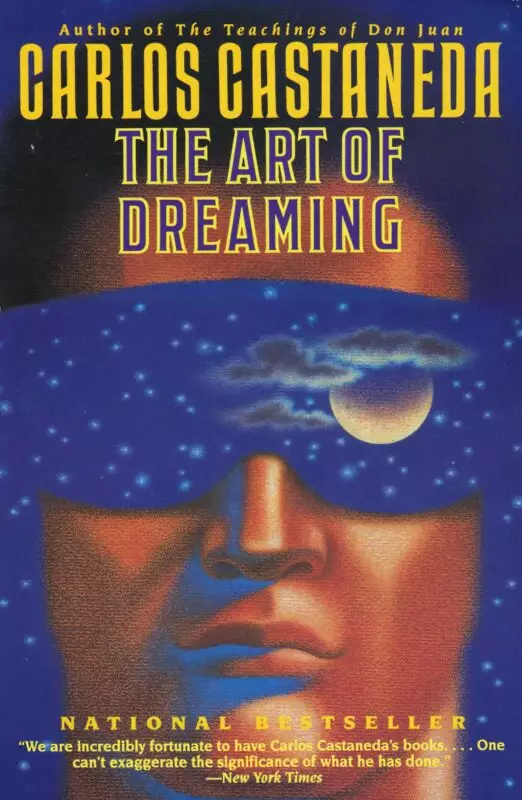
The Art of Dreaming

The fixation of the assemblage point – The Art of Dreaming

In this chapter, don Juan introduces the concept of “stalking” as the art of fixating the assemblage point, which is crucial for achieving perceptual “cohesion” in new worlds entered through dreaming. He explains that the mysterious voice Castaneda has been hearing is the “dreaming emissary,” a conscious but impersonal energy from the realm of inorganic beings, which he warns against trusting. To illustrate the long and complex history of sorcerers’ interactions with such forces, don Juan tells the story of “the tenant,” a death-defying sorcerer from antiquity who survives for millennia by forming a symbiotic, energy-draining relationship with his lineage of naguals. The chapter culminates with Castaneda performing a practical exercise in stalking, using a mesquite tree to fixate a minute shift in his assemblage point, which plunges him into a fully sensorial other world and highlights the difference between the “human unknown” sought by old sorcerers and the “nonhuman unknown” which is the goal of modern ones.

The fixation of the assemblage point – The Art of Dreaming Read More »

The second gate of dreaming – The Art of Dreaming

In this chapter, Carlos Castaneda details his journey through the “second gate of dreaming.” After mastering the first gate by developing his “dreaming attention,” he is instructed by don Juan that the next task is to learn to move from one dream into another. This practice leads him to experience jolts of fear, which don Juan reveals are the initial contacts from conscious, non-biological entities called “inorganic beings.” These beings are attracted to the energy charge created by dreamers. After Castaneda’s dreams become fixated on two candle-shaped inorganic beings, don Juan guides him to confront them in the waking world. Castaneda physically wrestles one of the beings, an act which establishes a “watery” or emotional connection that don Juan warns is dangerous and can lead to dependency, even as it opens the door to forming alliances and exploring other worlds.

The second gate of dreaming – The Art of Dreaming Read More »

Sorcerers of antiquity: an introduction – The Art of Dreaming

In this chapter, Carlos Castaneda recounts don Juan’s explanation of the foundational principles of sorcery, established by brilliant but obsessive “sorcerers of antiquity.” Don Juan contrasts their focus on concrete power with modern sorcerers’ search for abstract freedom. The core discovery of the ancients was the ability to perceive energy directly, which they called “seeing.” This led to the identification of the human energy form as a “luminous egg” and its crucial feature: the “assemblage point,” a spot of brilliance that assembles filaments of universal energy into our perception of the world. Castaneda learns that displacing this point—either as a “shift” within the luminous egg or a “movement” outside of it—is the key to perceiving other worlds and is the basis for the “second attention” and the art of “dreaming,” which is defined as the willful displacement of the assemblage point during sleep.

Sorcerers of antiquity: an introduction – The Art of Dreaming Read More »

Author’s Note – The Art of Dreaming

In this introductory note, Carlos Castaneda clarifies his use of the term “sorcery” to describe the teachings of his mentor, don Juan Matus, distinguishing it from conventional definitions. He explains that for don Juan, sorcery is about manipulating perception to access other real worlds, a practice called “the art of dreaming.” Castaneda recounts his own experiences learning this art, his interactions with two distinct groups of apprentices, and the challenges of reconciling his experiences in the “second attention” with everyday reality. He states that the purpose of this book is to rearrange and present don Juan’s lessons on dreaming in a linear fashion, made possible by years of dedicated practice, and to ultimately explain the legacy don Juan left to his final students as an act of gratitude.

Author’s Note – The Art of Dreaming Read More »

Translate »